
Confirmation of Accuracy
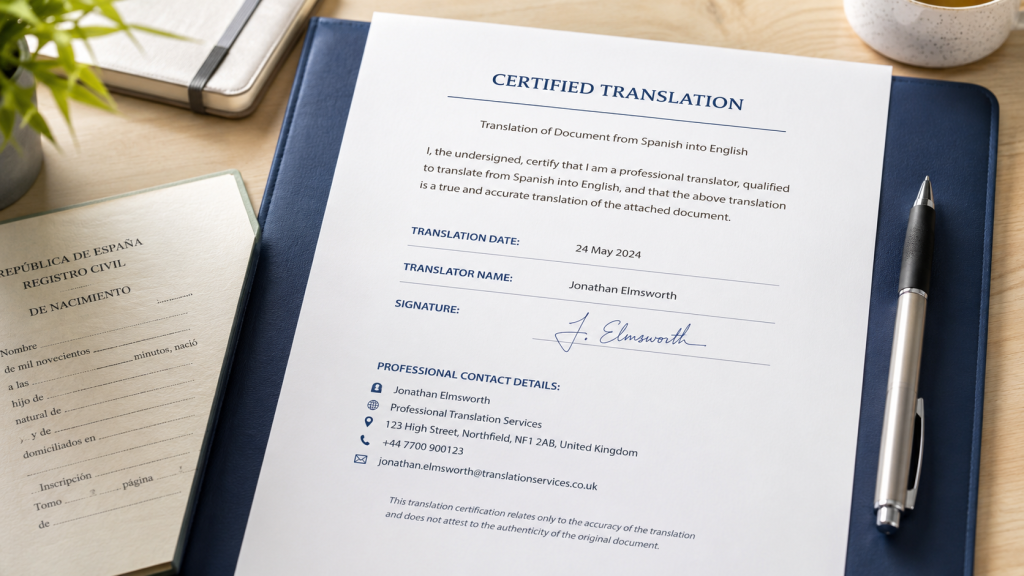
A written statement confirms that the translation accurately represents the original document.
Professional certified translation of foreign-language documents for Home Office immigration, settlement, nationality and other official applications. Send a clear copy online and receive a complete English translation prepared with the certification details needed for independent verification.
When supporting evidence is not in English or Welsh, the relevant Home Office application may require a full translation so the document can be understood and the person or company responsible for translating it can be independently verified.
The completed translation should accurately represent the readable content of the original and contain the certification information required by the relevant application route.
Requirements can vary, so include any caseworker request, evidence checklist or supporting-document instructions when sending your documents.
Home Office immigration guidance for a number of application routes requires enough information to confirm the translation's accuracy and identify the translator or translation company responsible for it.
A written statement confirms that the translation accurately represents the original document.
The translation or certification clearly records the relevant completion date.
The translator or authorised official of the translation company is clearly identified.
Relevant Home Office immigration guidance requires the translator or authorised company official to sign.
Professional contact information allows the translation provider to be independently verified.
Additional credentials or information should be included where your particular application instructions require them.
Foreign-language documents may form part of immigration, nationality, settlement, family and other Home Office submissions.
Personal, financial, employment, academic and civil-status documents used as supporting evidence.
Marriage, birth, divorce, identity and other documents relating to family relationships.
Supporting records provided as part of a settlement application.
Civil-status, identity and other supporting evidence for nationality procedures.
Certificates and records used to demonstrate family relationships and identity.
Foreign-language evidence requested while an application or case is being considered.
Send related documents together where possible. This can help keep names, dates, addresses and terminology consistent throughout the translation set.
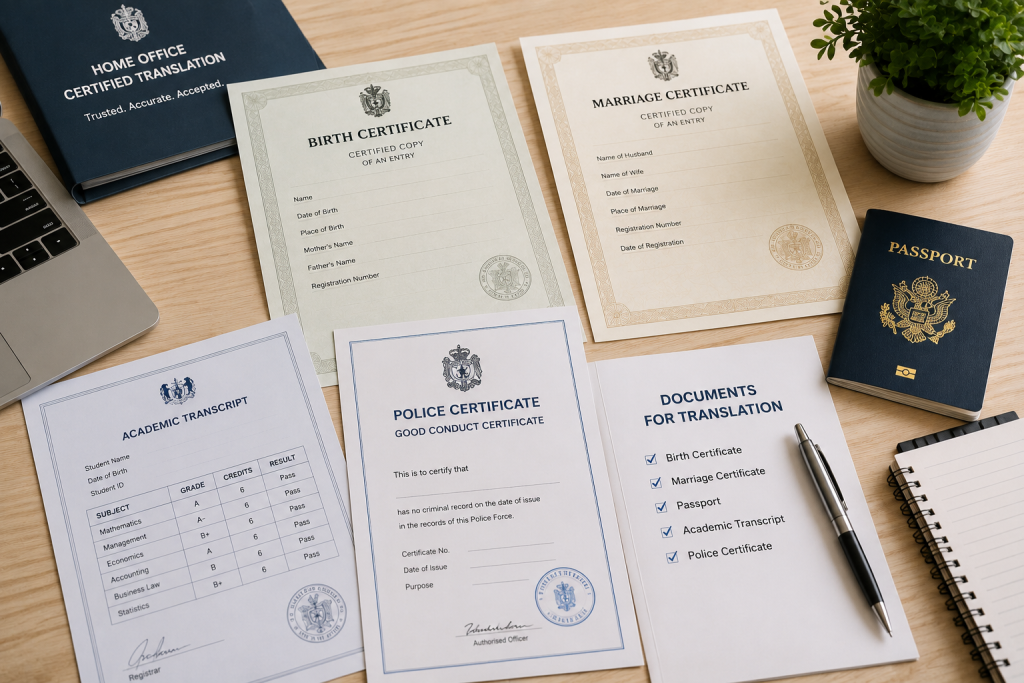

Your document is reviewed before translation begins so the language, intended use, price, certification requirements and available turnaround can be confirmed.
Send a clear PDF, scan or photograph of every relevant page.
Tell us the source language, intended Home Office use and submission deadline.
The complete file is reviewed so the price and available delivery option are clear before work begins.
Names, dates, figures, terminology, visible markings and completeness are reviewed during preparation.
Receive the certified digital document, with printed copies available where required.
Complete files and clear instructions make it easier to confirm the correct translation service, quotation and available turnaround at the beginning.
Official documents contain identity information, dates, reference numbers, stamps and other details that need careful comparison with the original.

Complete, readable documents and consistent personal details reduce avoidable questions during translation and document preparation.
Send the complete document, including relevant reverse sides and attached pages.
Avoid blur, glare, shadows, missing corners and cropped document edges.
Provide the spelling shown in the relevant passport where several English transliterations are possible.
Explain the intended Home Office use so the correct certification requirements can be considered.
Accuracy confirmation, identifying information, signature and professional contact details should not be overlooked where required.
Add notarisation, apostille or legalisation only when the relevant receiving authority requires it.
These are current starting rates. Your complete document is reviewed before the final price and available turnaround are confirmed.
Two-day certified translation for suitable non-urgent documents.
One-day service for suitable documents where confirmed capacity is available.
Completion within 24 hours where the document, language and current capacity allow.
Language pair, amount of text, handwriting, formatting, document condition, certification requirements and additional formalities can affect the final quotation.
UK Visas and Immigration is part of the Home Office, but visa applications have route-specific supporting-document requirements. If your translation is specifically for a UK visa, settlement or immigration application, our UKVI page gives more detailed route-focused information.
Practical answers about certification, document submission, pricing, additional formalities and delivery.
It is a complete translation of a foreign-language document supplied with certification information confirming its accuracy and identifying the translator or translation company responsible for the work so the translation can be independently verified.
Current Home Office immigration guidance for a number of routes requires confirmation that the translation is accurate, the date of translation, the full name and signature of the translator or authorised company official, and professional contact details. Additional requirements can apply to particular routes.
Rather than relying on an “approved translator” label, check the certification requirements for your exact application. The translation should be professionally prepared and include the information required by the relevant Home Office process.
UK Visas and Immigration forms part of the Home Office, but this page covers broader Home Office certified-translation requirements. Visa-specific applicants can use the dedicated UKVI certified translation service for more route-focused information.
A complete and readable scan, PDF or photograph can normally be used for quotation and translation. Your application may separately require you to present or submit the original-language document, so follow the instructions for your particular route.
Notarisation is not automatically required for every Home Office translation. Certified translation, notarisation and apostille legalisation are separate requirements. Additional formalities should normally be added only when the relevant authority requests them.
Yes. Sending related documents together can help keep names, addresses, dates and terminology consistent throughout the document set.
Standard certified translation starts from £40 per page. Express service starts from £65 per page and Same Day service starts from £100 per page. The final quotation depends on the complete document, language pair, complexity, requirements and requested turnaround.
Express and same-day options may be available depending on the language, document length, readability, complexity and current capacity. Include your actual submission deadline when sending your documents.
Certified digital delivery is available, with printed copies available where required. Confirm the format required for your submission when ordering.
Upload the complete document and include its source language, intended Home Office use and submission deadline. Your file can then be reviewed so the appropriate service, final quotation and available delivery time are confirmed before translation begins.