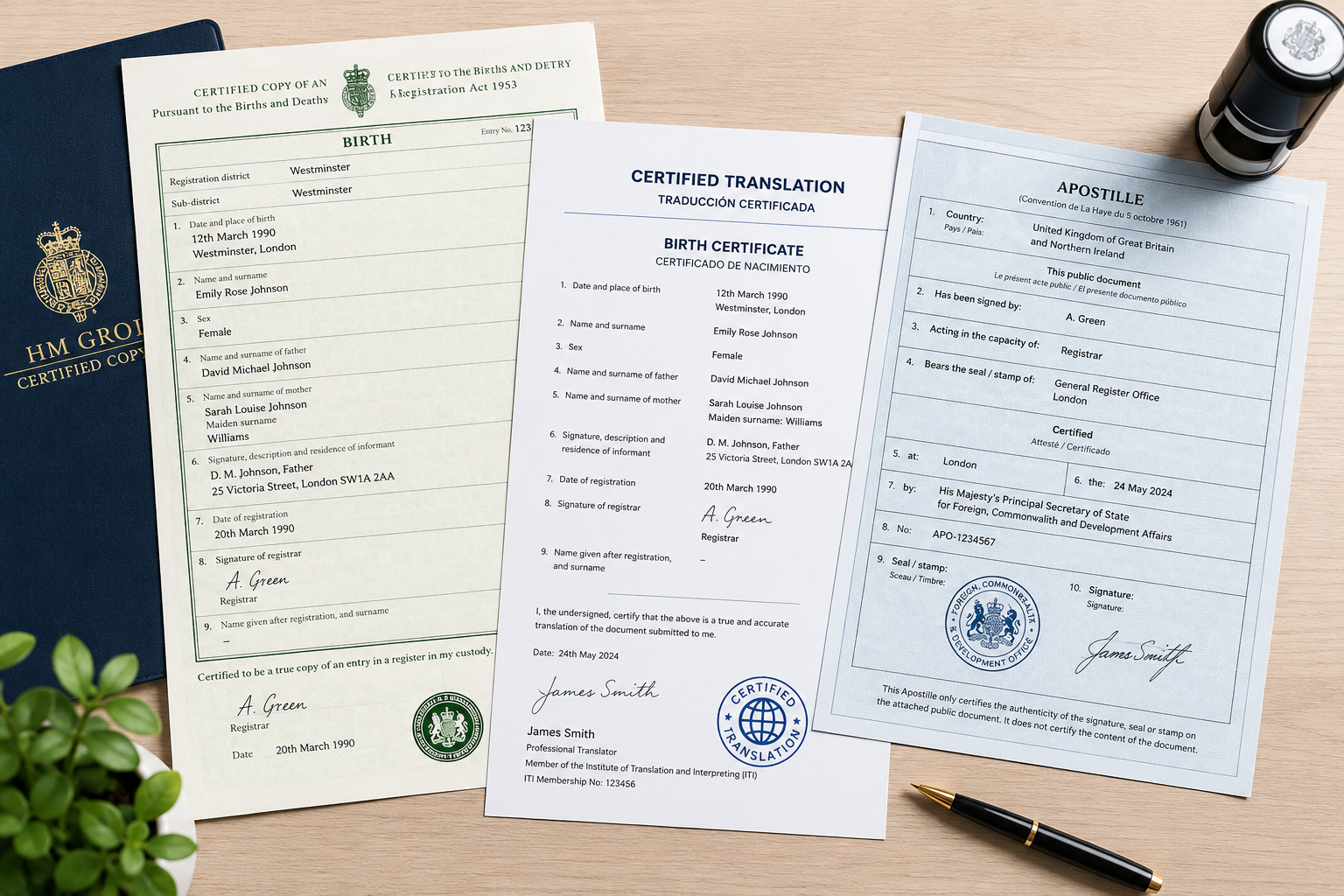
Short answer: there is no single rule that says every document must always be translated before an apostille or always after it. The correct order depends on the document, the country where it was issued, the destination country and the receiving authority’s instructions.
For UK-issued documents, the Foreign, Commonwealth & Development Office Legalisation Office legalises eligible documents by checking the relevant signature, stamp or seal and attaching an apostille. Translation is a separate step. Before paying for either service, confirm what the organisation receiving the document actually wants.
Should I get an apostille before or after translation?
The safest sequence is to start with the receiving authority. Ask whether it requires the original document, a certified copy, an apostille, a translation of the original, a translation of the apostille, or a particular combination of those items.
For many UK documents used overseas, a common route is:
- Confirm the destination authority’s requirements.
- Check whether the UK document is eligible for legalisation.
- Obtain any required solicitor or notary certification before legalisation.
- Obtain the apostille from the UK Legalisation Office.
- Translate the final document set, including the apostille if the receiving authority expects it in the target language.
That sequence is not universal. Some authorities want a translation certified or notarised before a legalisation step, while others want the apostilled original translated afterwards. The destination authority’s rules take priority.
Does an apostille itself need to be translated?
Sometimes. An apostille contains official wording and verification details. If the authority receiving the document does not accept the language used on the apostille, it may ask for that certificate to be translated as part of the complete document pack.
Do not assume that only the underlying certificate needs translation. If the apostille has already been attached, send the translator the complete legalised document so they can see every page, stamp, seal and certificate that forms part of the submission.

What does the UK Legalisation Office actually apostille?
The UK Legalisation Office checks whether the signature, stamp or seal on an eligible UK document matches its records. If the check succeeds, it legalises the document by attaching an apostille. Documents issued outside the UK must normally be legalised in the country where they were issued.
Some documents can go directly to legalisation, including certain court-sealed documents, public registry certificates and government documents. Other documents may first need certification by a UK public official such as a solicitor or notary.
See the official GOV.UK document legalisation guidance before sending an original or certified copy.
What if I need both translation and an apostille?
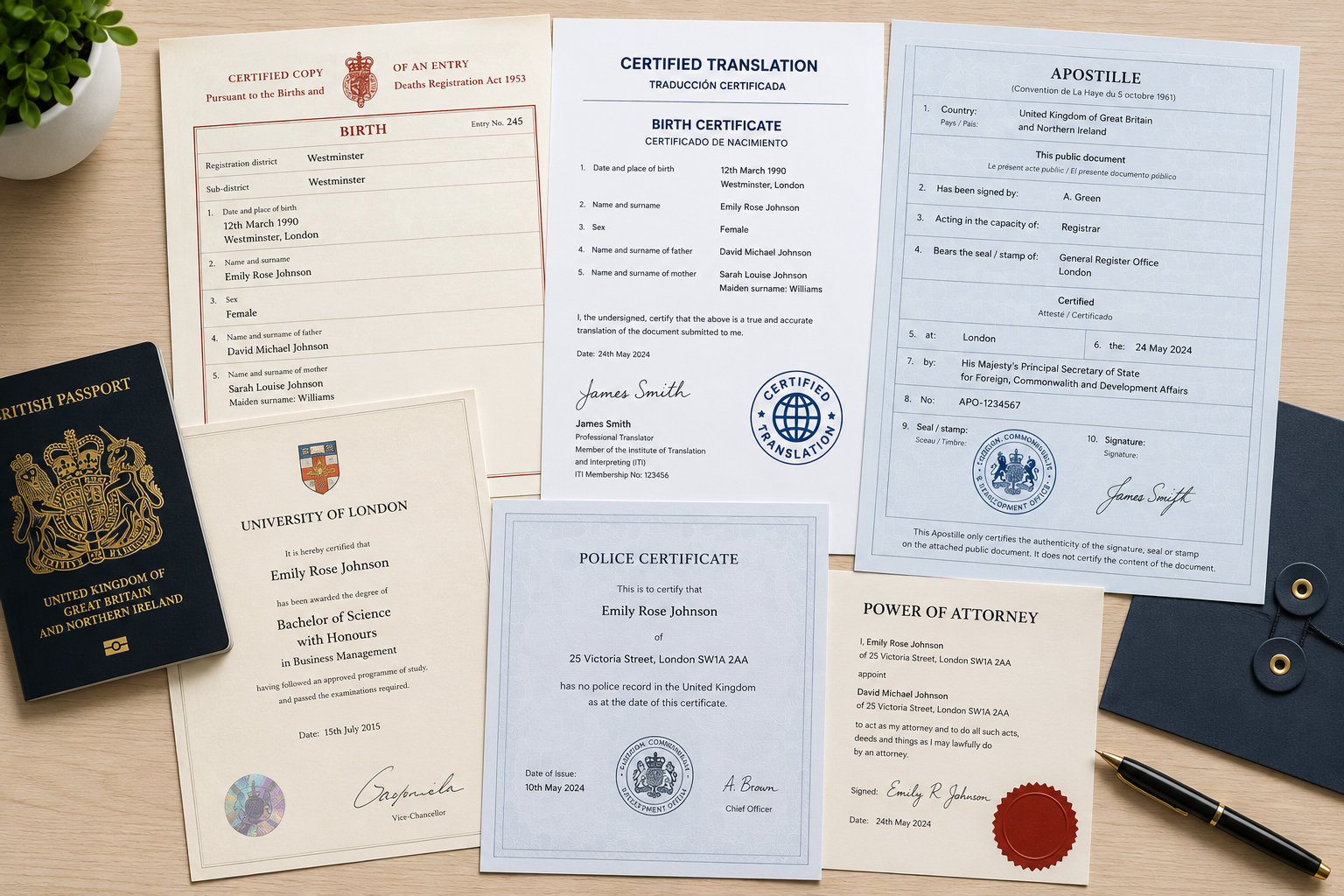
If you already know that both services are required, send the complete document and the recipient’s written instructions before starting. This helps avoid paying for a translation of the wrong version or legalising a document that the recipient will not accept.
Our Apostille & Translation Services UK page explains the combined service route. If the main requirement is UK legalisation rather than translation, use the UK Apostille Service & Document Legalisation guide instead.
Do I need a certified translation as well?
If a UK authority asks for a certified translation into English or Welsh, GOV.UK says the translator should confirm in writing that the translation is a true and accurate translation of the original, state the date of translation, and provide their full name and contact details.
Different overseas authorities can impose different certification, sworn-translation, notarisation or translator-registration rules. Our certified translation requirements guide covers the UK side in more detail.
A simple decision checklist
- Where was the document issued? UK and non-UK documents follow different legalisation routes.
- Where will it be used? The destination authority determines what it will accept.
- Does the recipient require an original or certified copy? Confirm this before legalisation.
- Does the apostille also need translation? Ask whether every part of the legalised pack must be in the destination language.
- Is notarisation required? Do not add notarisation automatically unless the route calls for it.
Frequently asked questions
Can you apostille a translation?
Potentially, but eligibility depends on how the translation has been certified and what signature or seal the Legalisation Office can verify. Check the required route before arranging the translation.
Can I translate an apostilled document afterwards?
Yes, this is a common route where the receiving authority wants the final legalised document pack translated. The translator should be given the complete document including the attached apostille.
Is an apostille the same as a certified translation?
No. A certified translation addresses the translated content and certification statement. An apostille is a legalisation certificate used to authenticate a relevant signature, stamp or seal for overseas use.
Does every translated document need an apostille?
No. Apostille and translation are separate requirements. Only obtain an apostille when the authority receiving the document requires legalisation.
Last reviewed: 5 October 2026. Legalisation and translation requirements can change. Always check the current instructions of the authority receiving your document before ordering either service.